

How Much Does a Welding Robot Really Save Compared to Hiring Welders? A 2026 Cost Breakdown
Jun 17,2026
Every metal fabrication shop faces the same question: should I hire another welder or invest in a welding robot? The answer isn't just about technology—it's about math. Labor costs keep rising, skilled welders are harder to find, and production deadlines don't wait. Meanwhile, welding robots have become more affordable, easier to program, and more reliable than ever. But how much does a welding robot really save compared to hiring a human welder? This article breaks down the real costs, hidden expenses, and ROI calculations so you can make an informed decision for your shop. As a leading manufacturer of industrial robots, SZGH provides the data and insights you need to evaluate automation against traditional labor.
1. The True Cost of Hiring a Welder: Beyond the Hourly Wage
Most shop owners calculate labor costs based on the hourly rate. But the real cost of a welder is much higher. Let's look at the full picture for a full‑time welder in a typical mid‑sized fabrication shop.
Annual cost breakdown for one full‑time welder (US market example):
Cost Component | Amount | Notes |
Base hourly wage | $22-28 / hour | Depending on skill level and region |
Overtime (average 5 hours/week) | +$4,000-6,000 | Time and a half after 40 hours |
Payroll taxes (FICA, unemployment) | +7-10% of base | Employer portion |
Health insurance contribution | +$5,000-8,000 / year | Varies by plan |
Retirement contribution (401k match) | +$1,000-2,000 | Typical 3-5% match |
Paid time off (holidays, vacation, sick) | +$3,000-5,000 | Paid days without production |
Training and certifications | +$1,500-3,000 | AWS certs, safety training, ongoing education |
Safety equipment (helmet, gloves, jacket) | +$500-1,000 | Annual replacement |
Workers' compensation insurance | +$2,000-4,000 | Based on risk classification |
Recruiting and onboarding (if turnover) | +$5,000-10,000 | Not annual but amortized over 2-3 years |
Total annual cost for one full-time welder | $55,000 – $80,000+ |
|
For a shop running two shifts (two welders per shift), that's $110,000 – $160,000 per year in labor costs alone. And this doesn't include indirect costs like scrap rework, quality issues from fatigue, or lost productivity during breaks.
2. The Hidden Costs of Manual Welding That No One Talks About
Beyond direct wages, manual welding carries additional costs that are often overlooked.
· Rework and scrap: Even skilled welders produce defects. Industry averages show 5‑15% rework rates for manual welding, depending on complexity. Rework consumes materials, labor, and machine time.
· Inconsistent cycle times: A welder working at 7 a.m. is faster than the same welder at 4 p.m. Fatigue slows production by 10‑20% over a shift.
· Material waste: Poor torch angle and travel speed can cause excessive spatter, wasting filler wire and shielding gas. Manual MIG welding often uses 15‑25% more consumables than robotic welding.
· Downtime between shifts: Handovers, breaks, shift changes, and clean‑up add 30‑60 minutes of non‑productive time per shift.
· Safety incidents: Welding is hazardous. A single workers' comp claim for a burn or eye injury can cost $20,000‑50,000 in direct expenses plus lost time.
When you add these hidden costs, the true annual burden of a manual welding station can exceed $100,000 per shift.

3. What a Welding Robot Costs: Purchase, Installation, and Operation
Now let's look at the investment side. A complete welding robot cell includes the robot arm, controller, welding power source, torch, safety fencing, and installation. Here's a realistic budget for a SZGH welding robot system.
Initial investment (typical single‑station cell):
Component Cost Estimate
6‑axis welding robot arm (e.g., SZGH-H2100-B-6) $12,000 – 18,000
Robot controller and teach pendant $3,000 – 5,000
Welding power source (MIG/MAG) and wire feeder $4,000 – 7,000
Welding torch, cables, and accessories $1,000 – 2,000
Safety fencing and light curtains $2,000 – 4,000
Installation, programming, and training $3,000 – 6,000
Total initial investment $25,000 – 42,000
Annual operating costs:
Cost Component Amount
Electricity (robot + welder) $500 – 1,000 / year
Consumables (wire, gas, tips, nozzles) $1,500 – 3,000 / year
Preventive maintenance (annual service) $800 – 1,500 / year
Spare parts (motors, reducers, etc.) $500 – 1,000 / year (average)
Operator training (annual refresher) $500 – 1,000 / year
Total annual operating cost $3,800 – 7,500 / year
The robot itself depreciates over 5‑7 years, but even if you fully expense it in year one, the numbers are compelling.

4. Productivity Comparison: One Welding Robot vs. One Welder
A welding robot doesn't just replace a welder—it often outperforms one by a wide margin.
Metric Human Welder (8‑hour shift) Welding Robot (8‑hours) Advantage
Arc‑on time (percentage of shift actually welding) 30‑50% 85‑95% Robot welds 2‑3x more minutes per shift
Effective arc‑on minutes per shift 150‑240 minutes 400‑450 minutes 2x more output
Travel speed consistency Varies (±20%) ±1% Less rework
Breaks and shift change downtime 60‑90 minutes 0 minutes (can run unattended) More productive hours
Overnight operation No Yes (lights‑out) Potential 24/7 production
Annual output (single shift basis) 1x 2‑2.5x Robot equals 2‑2.5 welders
A single welding robot running one shift can produce the same output as two to two and a half manual welders. If you run two shifts, one robot can replace four to five welders.
5. Calculating ROI: How Many Months to Pay Back?
Let's use realistic numbers for a mid‑sized fabrication shop that currently employs four welders across two shifts.
Scenario: Replace two welders with one welding robot
Cost/ Savings Item Amount
Annual cost of two welders (including benefits, overtime, hidden costs) $140,000
Total investment for one SZGH welding robot cell $35,000 (mid‑range)
Annual operating cost of robot $5,000
Net annual savings (labor savings – robot operating cost) $135,000
Payback period (investment ÷ net annual savings) 3.2 months
Even if you keep some welders for complex or low‑volume jobs and only replace one welder, the math still works:
Scenario Payback Period
Replace 1 welder ($65,000 annual cost) with one robot ($35k investment) ~6‑8 months
Replace 2 welders ($130k) with one robot ($40k investment) ~4 months
Replace 4 welders ($260k) with two robots ($80k investment) ~4 months
Most shops see full ROI within 6 to 12 months. After that, the robot generates pure profit.

6. Beyond Labor Savings: Quality, Capacity, and Competitiveness
The financial case for a welding robot goes beyond direct labor substitution.
Quality improvement: Robotic welding delivers consistent penetration, bead appearance, and lack of defects. Shops report 50‑80% reduction in rework after automation. That means fewer customer returns, less material waste, and higher margins.
Capacity without overtime: When a rush order comes in, a welding robot can run overnight or on weekends without overtime pay. Manual welders would require premium rates and still face fatigue limits.
Winning more business: Many OEMs and large contractors now require robotic welding for repeatability and traceability. Having a SZGH welding robot on your floor opens doors to higher‑value contracts.
Worker retention and safety: Robots handle the repetitive, high‑risk welds. Your skilled welders can focus on fit‑up, inspection, and complex joints—work that is more engaging and less hazardous.
7. Why SZGH Welding Robots Offer the Best Value
SZGH has engineered its welding robots to deliver maximum return on investment for small and medium‑sized shops.
·Affordable upfront cost: Our systems start under $25,000 for basic arc welding cells – significantly less than premium European or Japanese brands.
· Easy programming: Drag‑and‑teach and intuitive teach pendant mean your existing welders can learn to program in days, not months.
· Low maintenance: Integrated design with fewer external cables reduces downtime and spare parts costs.
· Lifelong support: 2‑year warranty plus remote diagnostics and fast spare parts delivery keep your robot running.
· Proven reliability: Thousands of SZGH welding robots are already operating in fabrication shops worldwide, from automotive parts to agricultural equipment.
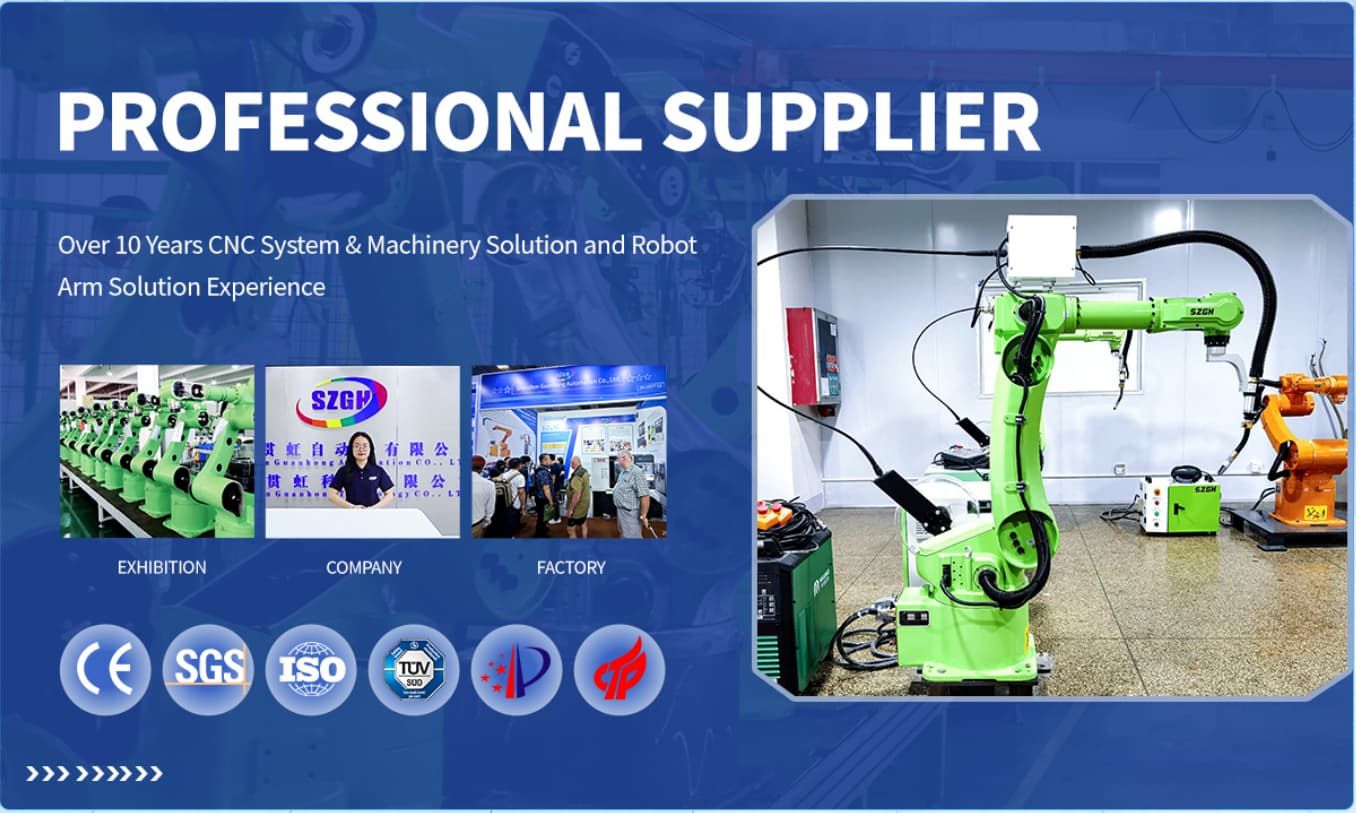
8. Conclusion: The Numbers Don't Lie – Welding Robots Save Money
When you run the full cost analysis, the answer is clear: a welding robot saves a substantial amount compared to hiring manual welders. The payback period is measured in months, not years. The ongoing savings free up capital for growth. And the improvement in quality and capacity makes your shop more competitive.
Don't just take our word for it. Calculate your own numbers using the framework above. Then talk to SZGH. We'll help you select the right welding robot for your application and build a customized ROI model for your shop.
Ready to see how much a welding robot could save you?
Contact SZGH's welding automation specialists] for a free, no‑obligation cost analysis. We'll compare your current welding labor costs to a robotic solution and show you the exact payback period.
MORE BLOG


Copyright © ShenZhen GuanHong Automation Co.,LTD All rights reserved.
