

Precision vs. Power: Welding Robot Application Key Differences Between Steel Structures and Sheet Metal
Jan 16,2026
In the diverse world of fabrication, not all welding robot applications are created equal. The approach, technology, and even the choice of robot differ dramatically when moving from the heavy frames of steel structures to the delicate assemblies of sheet metal. Understanding these key differences is crucial for manufacturers to select the right automation, maximize quality, and avoid costly errors. As a leader in flexible automation, SZGH provides tailored solutions for both ends of the spectrum. This guide breaks down the distinct challenges and requirements for these two primary welding robot applications.
1. Fundamental Distinctions: Scale, Material, and Purpose
The core difference lies in the product's function and the material's physical properties, which dictate the entire welding robot application strategy.
Steel Structure Welding: This welding robot application focuses on strength and structural integrity. Common in construction, shipbuilding, and heavy machinery, it involves thick materials (often 6mm to 50mm+), long continuous welds, and high heat input. The primary goal is to create load-bearing joints capable of withstanding immense stress, vibration, and weather. Defects like lack of penetration are critical failures.
Sheet Metal Welding: This welding robot application prioritizes precision, aesthetics, and minimal distortion. Common in automotive bodies, electronics enclosures, appliances, and furniture, it involves thin materials (0.5mm to 3mm), short or intricate weld seams, and controlled heat. The goal is to create a strong, leak-proof, and cosmetically clean joint without warping the delicate workpiece.

2. Welding Process & Technique: High-Heat Input vs. Low-Distortion Control
The chosen welding process and how it's applied are the first major technical divergences in these welding robot applications.
Processes for Steel Structures:
Submerged Arc Welding (SAW): Often used for long, straight seams on thick plates. A welding robot can automate the travel and wire feed with high deposition rates.
Gas Metal Arc Welding (GMAW/MIG) with Spray Transfer: The workhorse for structural welding robot applications. It uses high current and voltage to achieve deep penetration on thick sections. SZGH robots are programmed with weaving patterns to fill large groove welds efficiently.
Processes for Sheet Metal:
Gas Metal Arc Welding (GMAW/MIG) with Short-Circuit Transfer: This lower-heat variant is essential for sheet metal welding. The wire “short-circuits” to the workpiece repeatedly, minimizing heat input to prevent burn-through.
Gas Tungsten Arc Welding (GTAW/TIG): Preferred for the highest quality, aesthetic welds on stainless steel or aluminum sheet metal. It offers unparalleled control but is slower, making precision welding robot applications ideal for automating it.
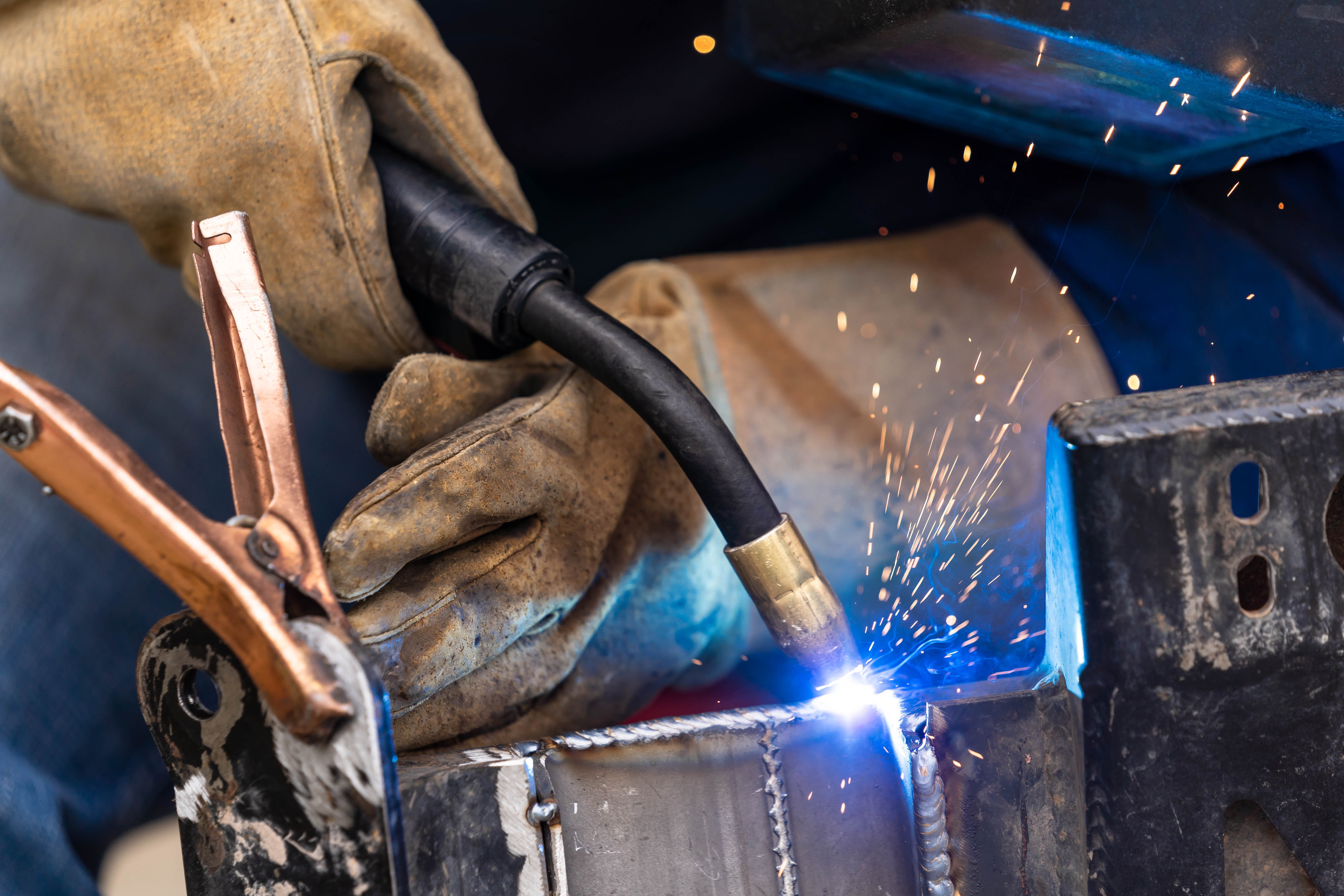
3. Robot System Requirements: Power & Reach vs. Speed & Accuracy
The physical and technical demands on the welding robot itself vary significantly, influencing the system design for each welding robot application.
Robot for Steel Structures:
High Payload & Large Reach: Needs to handle heavy welding torches and sometimes positioners for large workpieces. A SZGH heavy-duty welding robot with a 20kg+ payload and a reach over 2.5 meters may be required.
Ruggedness: Must operate reliably in environments with spatter, dust, and vibration.
Path Consistency Over Speed: While not slow, the priority is maintaining a steady arc and weave pattern over long, sometimes less complex, paths.
Robot for Sheet Metal:
High Accuracy & Speed: Demands exceptional repeatability (±0.05mm or better) to follow tight seams on small parts and high speed to maintain cycle times. A SZGH high-precision 6-axis robot is typically used.
Advanced Features: Often requires integrated seam tracking (laser or touch) to compensate for the natural fit-up variance in thin parts, and through-the-arc tracking to maintain perfect torch position.
Compact Design: May need to work within confined spaces or on small workstations.
4. Fixturing & Positioners: Handling the Mass Difference
How the workpiece is held and presented is a critical, often overlooked, aspect of a successful welding robot application.
For Steel Structures: Fixturing is massive and custom-built to clamp large, heavy components. Heavy-duty positioners (headstock/tailstock or turntables) are frequently integrated with the welding robot. The robot and positioner move in coordinated motion to keep the weld in the optimal flat or horizontal position, vastly improving quality and deposition rate.
For Sheet Metal: Fixturing must be precise and often complex to hold multiple thin parts in perfect alignment with minimal gap. Due to low weight, high-speed servo positioners are used to quickly rotate the part, presenting all seams to the robot efficiently. The fixtures themselves must act as heat sinks to draw heat away and prevent distortion.

5. The SZGH Advantage: Tailored Solutions for Both Worlds
SZGH excels by not offering a one-size-fits-all welding robot, but by providing application-engineered solutions that address these key differences.
For Demanding Steel Structure Applications: We provide high-stability welding robots with robust arms and controllers capable of executing complex weaving patterns and synchronizing with large external axes. Our partnership ensures the system is built to handle the thermal dynamics and material challenges of thick-section welding.
For Precision Sheet Metal Welding: We offer agile, high-speed robots integrated with advanced sensing packages. Our SZGH Smart Welding Package includes features like adaptive fill for gap bridging and spatter reduction algorithms, which are critical for cosmetic sheet metal welding. Our intuitive programming makes it easier to manage the numerous short, varied weld seams typical in this field.
Conclusion: Matching the Robot to the Metal
Choosing the right automation for a welding robot application is fundamentally about understanding the material. Steel structure welding demands a powerful, robust system focused on deposition integrity, while sheet metal welding requires a finesse-driven, precise system focused on heat control.
By recognizing these key differences—in process, technique, robot specs, and tooling—manufacturers can invest wisely and avoid the pitfalls of misapplied technology. Partnering with an expert like SZGH, who has deep experience across the entire spectrum of welding robot applications, ensures you get a solution not just for welding, but for welding your specific product with optimal quality and efficiency.

MORE BLOG


Copyright © ShenZhen GuanHong Automation Co.,LTD All rights reserved.
